I’ve always been a rationalist and an agnostic, inclined to believe only in the explainable. Spirituality has still sat at the fringes of my experience, from the occasional unexplainable thing to a quiet, persistent interest in it all. I was curious but sceptical, particularly of organised religion. Buddhism was the tradition I’d engaged with least. My impression of it was vague and secondhand, more shaped by Western popular culture than anything of substance.
There’s a funny way that things come to fruition. You go looking for some deeper meaning and find nothing. Then sometime later, out of nowhere, an experience arrives that links straight back to what you’d been searching for, and things quietly fall into place. You could call it chance, or fate. I suspect it’s closer to what happens when an intention stays steadfast for long enough.
Music and Flow
I’ve been thinking about the parallels between meditation, music and the idea of flow, and I’ve come to believe that the modern concept of flow is an interpretation or age-old spiritual practices. By flow I mean the state where the rational, thinking mind is quietened and some degree of mastery lets you be fully present and experiential, rather than narrating what you’re doing while you do it.
For me this has always run through music. Playing instruments and slipping into a flow state, then DJing and finding it there too, and more recently seeing how flow is a cornerstone of jazz music, which makes the whole thing explicit. Improvisation in jazz is flow as a core tenet rather than an occasional byproduct. The musicians are responding to one another in the moment, with no fixed arrangement and no predetermined outcome, and each performance exists once before it’s gone. For a music built so completely on presence, it turns out to be a good companion for thinking about time as well.
Following the Pull
My current engagement with spirituality has begun, once again, with music. I returned to the Akira soundtrack one evening, and became transfixed by the track Shohmyoh. It’s built on a form of Buddhist chanting called Shōmyō, used in the film to score the confusion of characters who turn to faith when faced with the inexplicable. This piece on the soundtrack goes into more detail.
![Geinoh Yamashirogumi – Symphonic Suite Akira [1988]](/_astro/akira.Crzpro-5_nSWXV.webp)
Just earlier to this I had already come across a CD of recorded Japanese Buddhist chants, by the Monks of the Eihei-ji, 曹洞宗檀信徒勤行, a 1972 recording of monks at the Eiheiji temple of the Soto school of Buddhism. I didn’t pay attention to any of those details at the time, but found the records a useful change of pace, something to put on when I needed to slow down, study Japanese, or quieten my mind.
Listen on Youtube here: 曹洞宗檀信徒勤行 - 肢副大本山水平寺維那部.
![大本山永平寺維那部 – 曹洞宗檀信徒勤行 [D-3009] (1972)](/_astro/themonksothefeiheiji1972.QH19liTE_Z1JFjId.webp)
From there I had the thought to learn a little more about Zen specifically, which I knew only as a Japanese strain of Buddhism. These weren’t deliberate steps so much as related interests I kept following. I went looking for audiobooks on Zen and, on recommendations from Reddit, landed on works by D.T. Suzuki and a more modern and accessible novel, One Blade Of Grass: Finding the Old Road of the Heart, a Zen Memoir - Henry Shukman.
It turned out to be my first real exposure to Zen and it left a deep impression. Henry grew up in an academic setting in Oxford and, despite a relatively comfortable upbringing, spent much of his life affected by eczema and the psychological difficulties that came with it. He had also grown up steeped in rationalism and the scientific worldview. Many of his thoughts echoed my own, and in some ways validated them. That alone gave me more of an impetus to dig deeper.
Having finished it, I now understand that there are two main schools of Japanese Buddhism: the Soto sect, which centres on zazen, or seated meditation, and the Rinzai sect, which makes use of walking meditation and koans.
Sacred Spaces
Reading about Zen connected to something I’d felt for a long time without examining. There’s a particular sense of awe I get in sacred or spiritual spaces, usually churches, shrines or temples. I remember it strongly at Sacre Coeur and Notre Dame in Paris, at Todai-ji in Nara, and at the Shrines and Temples of Nikko. Natural environments produce the same feeling: hiking in forests and mountains brings a kind of awe that to me, belongs in the same category. Since those early experiences I’ve sought out shrines and temples in Japan specifically, not for any reason I could name but with a growing sense that I had been and still am, searching for something.
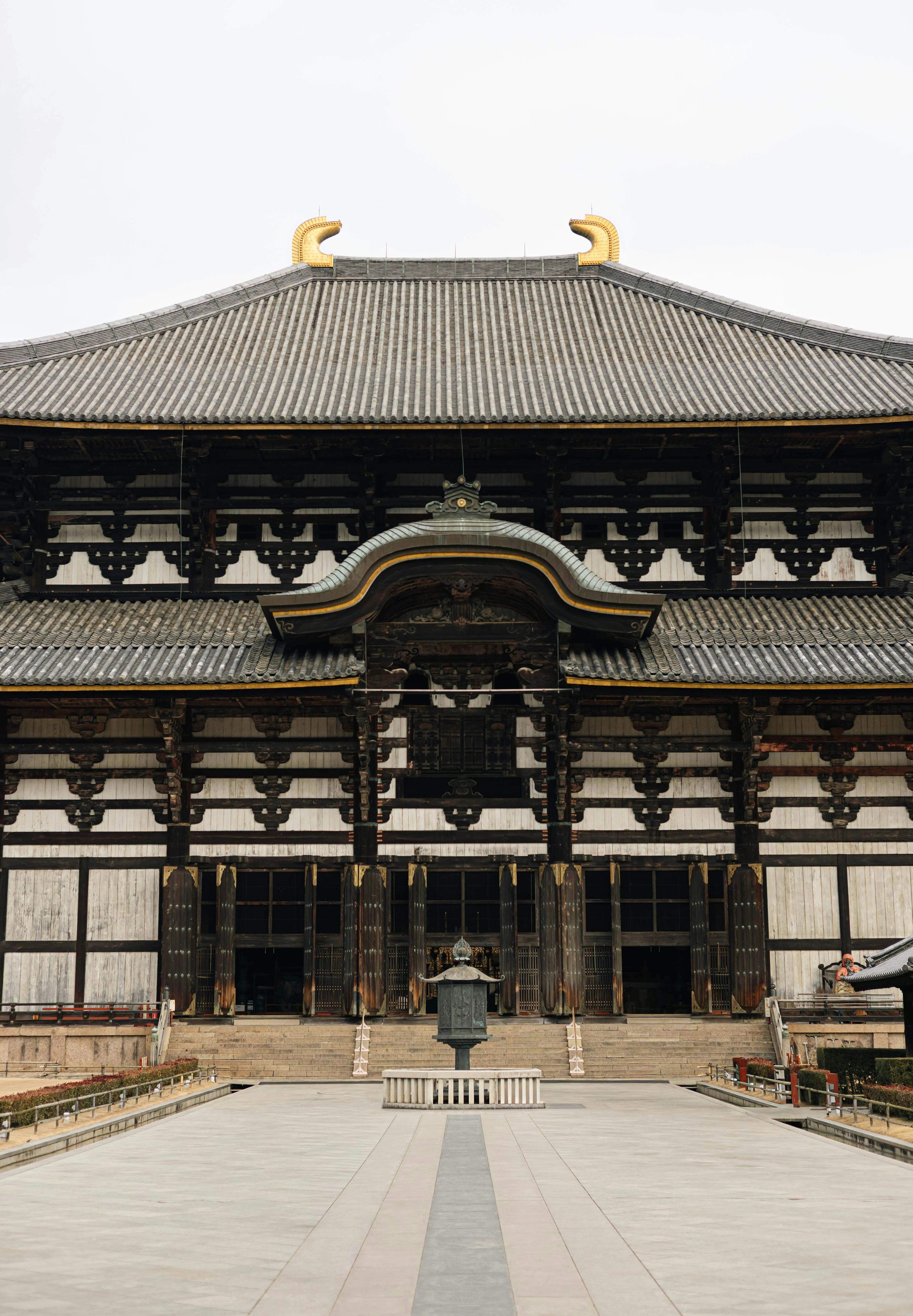 Photo by Vik Molina (@asecasvik) on Unsplash
When I sit with what that something might be, the clearest answer is peace. After a long stretch of reflection, when I ask myself what I actually want, peace is the first thing that comes to mind. On the surface that reads as a wish to quieten external issues, voices and influences, but I’m coming to understand that the most influential piece of the puzzle is myself. What I’m really after is an internal peace.
Equanimity and Acceptance
The other thing that surfaced from One Blade of Grass was the idea of acceptance: a kind of equanimity generated by the loosening of one’s own identity and the sense of a greater wholeness, or oneness, with everything. In the essence of Zen, that everything is in actuality a nothing.
Equanimity is a useful word here because it sits in both worlds. Psychology uses it to describe a stable, non-reactive relationship to experience, and Buddhist thought uses it in nearly the same sense. The convergence doesn’t seem accidental. What both point at is the distinction between a signal and a reality. The mind throws up a constant stream of responses, discomfort, self-criticism, doubt, and these are signals. They can be useful, but they aren’t always accurate accounts of what’s actually happening. Learning to notice a signal without immediately treating it as the truth is the practice. Not suppression, and not denial, just a little space between the alarm and the response. The same idea appears in meditation, in Zen, and in psychological approaches like cognitive behavioural therapy and acceptance and commitment therapy. The vocabulary changes but the mechanism is the same.
The Body as Practice
Running, yoga and cycling are the most reliable pathways to a flow state that I have access to day to day. Beyond flow, I’ve found that they offer a way to development appreciation for your own body, others and nature when paired with deliberate guidance and coaching. A long run or ride brings can slow down the thinking mind and give way to deeper consideration and intention. Spending time in the sauna also does something similar, in a state of balanced unease and discomfort which is more passive but just as good at producing a stretch of time where the internal noise settles. To me these activities are practice in the same sense that zazen is practice, deliberate and repeated, a return to a particular kind of presence.
Time as Passage
All of it is about being present. The thing that pushed me to take time seriously was the passing of my grandfather. Facing mortality makes it plain that time for any one person is not boundless, and that each particular moment will never come around again.
With each year I grow older, I realise more and more that I underestimate the importance of time. Not in the way of having “enough time”, where time is treated as a resource to be budgeted, but in the sense that the passage, and the passing, of time are what matter.
The pull toward some future, better version of things is everywhere. It can be read two ways. The useful one is that the pull often points at something you genuinely enjoy and want to do more of, and pursued long enough, with enough practice, that something can put you in a state of flow. The unhelpful one is when the pull turns purely anticipatory: a belief that there’s a right time waiting somewhere ahead. There isn’t, in any sense of the phrase. That belief becomes a rush toward the future, chasing a state of arrival that doesn’t exist. I’ll be happy when I hit this milestone, when I get that job, when I have that thing. You might build real happiness along the way, but the constant tracking of time rarely had much to do with how you got there.
On the other hand, valuing time more deliberately shouldn’t tip into its opposite. Toxic productivity applies the same kind of arbitrary pressure in a different direction, with fixed definitions of what a life well-spent looks like. The value isn’t in ticking off a timeline. It’s in each passing moment, and the passing of time in your work, your hobbies, your relationships becomes something to savour when you stop tracking it and start inhabiting it. The aim in the end is to live a little more openly, without self-imposed barriers.
How It Fits Together
I didn’t set out looking for a single answer. I was following music, then a chant from an anime soundtrack, then Zen, then the same old pull toward sacred spaces, and each of these arrived more or less on its own terms. What’s interesting is where they meet. Flow, equanimity and presence turn out to be the same idea approached from different directions: music gets there through improvisation, Zen through sitting, physical practice through movement, and psychology through learning to differentiate the signal or mental chatter from the real story. The peace I kept reaching for in those shrines and the equanimity I found in the book turn out to be the same thing.
Time as passage runs underneath all of it. Each of these practices is, in the end, about being in the moment you’re actually in, rather than the one ahead or the one behind. It isn’t a new idea, and it might be one of the oldest there is. But arriving at it through your own searching, in your own order, makes it feel like something you’ve understood rather than something you’ve read.
The search continues. There are more places of awe and reverence to find, more natural spaces to move through, and I’ve started looking into Jikishoan, a Soto Zen temple here in Melbourne founded under an ordained abbot. Whether that becomes a practice or just a visit, I’m not sure yet. But that’s the nature of searching. You don’t always know what you’re looking for until you find it.