I’ve always had music in my life. Growing up it covered a broad range: CDs on the drive to school, karaoke with family and friends at home, MTV on Foxtel. I learned piano on and off for a few years when I was younger, tried violin in junior school (the early starts for orchestra never worked for me), did a semester of saxophone and maybe half a year of drums in high school. It was only in my later high school years that I picked up guitar. Not needing to read sheet music, just tab, made it far more accessible to teach myself. Learning guitar sent me down the history of guitar and rock music (a lot of Bob Dylan, The Beatles, Led Zeppelin, Pink Floyd and Jimi Hendrix, skipping the 80s), after which I settled back into contemporary music.
During university my interest shifted to electronic and dance music, no doubt influenced by parties and late nights in dive bars, pubs and clubs. This took a real foothold during a half-year exchange in Lund, Sweden, where I found a housemate and lifelong friend who was, and still is, a successful DJ and producer. Listen for yourself if you don’t believe me: fastcastle.bandcamp.com. That’s where I learned to DJ and started producing my own music, which is a topic for another post.
All of these experiences gave me a deep appreciation for music of all kinds, and a better understanding of how it’s made and how it reaches you, whether through club speakers, studio monitors, or a pair of earbuds. My exposure to Hi-Fi itself was limited and I was always balancing music file sizes with quality and my own assessments of whether I could really hear the difference with lossless formats, but I followed audiophile discussions for years. I was never chasing the audiophile end-game. I just wanted faithful reproduction, and I valued speakers, headphones or earbuds that were easy and enjoyable to listen to. For me this usually meant a warmer tilted sound, and hence less fatigue with a slight roll-off on the highs.
Listening to music for enjoyment got derailed a bit during my DJing and music production years. I was mostly working off a pair of Adam A7X monitors in a square room full of hard surfaces, which did the sound no favours. I got by in the right listening position and at the right volume so the echoes didn’t get too bad. Room treatment was always on my mind but I never got around to it, and eventually I dropped production altogether. At the time it was more chore and mental toll than anything.
Finding Jazz
After a break from music in general, I came back to it with a new appreciation for jazz and for listening spaces. My jazz journey started in earnest mid-2023, seeing Terre Thaemlitz at a Melbourne festival play Peace Piece for nearly ten minutes with the whole crowd in silence. One of the most beautiful performances I’ve experienced. It wasn’t long before I heard the piece again and learned it was Bill Evans. He’s since become one of my favourite artists. I read 3 Shades of Blue by James Kaplan, worked through most of Miles Davis’ early discography, and started collecting jazz records.
Part of what I’ve come to love about jazz is that the recordings are live. You hear the room, whether that’s a studio or a venue with an audience present, people having dinner, laughing with friends, and my favourite, applauding after a track. That was a stark contrast to what I’d mostly been listening to while DJing and producing, which was nearly always a fixed, predetermined arrangement. Beats locked to a grid, songs blended to play as one continuous stream of rhythm and melody. After so long in that world, live and improvised music was a breath of fresh air. In jazz you’ll hear the same song played by different artists, or even by the same artist more than once (called standards), and every recording will be different due to interpretation but more so, due to the inherent aspect of improvisation that defines jazz. It’s a perfect vehicle for exploring Hi-Fi and the search for a system that makes you feel like you’re in the room with the performers.
The First Build
This was reinforced by my trips to Japan, where jazz plays in department stores, cafes and bars, and especially in jazz kissas, listening bars that are slowly becoming more popular worldwide. Around this time Ojas speakers showed up on my Instagram, and not long after I decided to build a pair as my first real home setup. I’d planned to buy the Ojas kit, but shipping from the US was prohibitive. Since Devon already provided all the parts list and instructions, I just had to replicate the cabinet as best I could. All credit to him for the design.
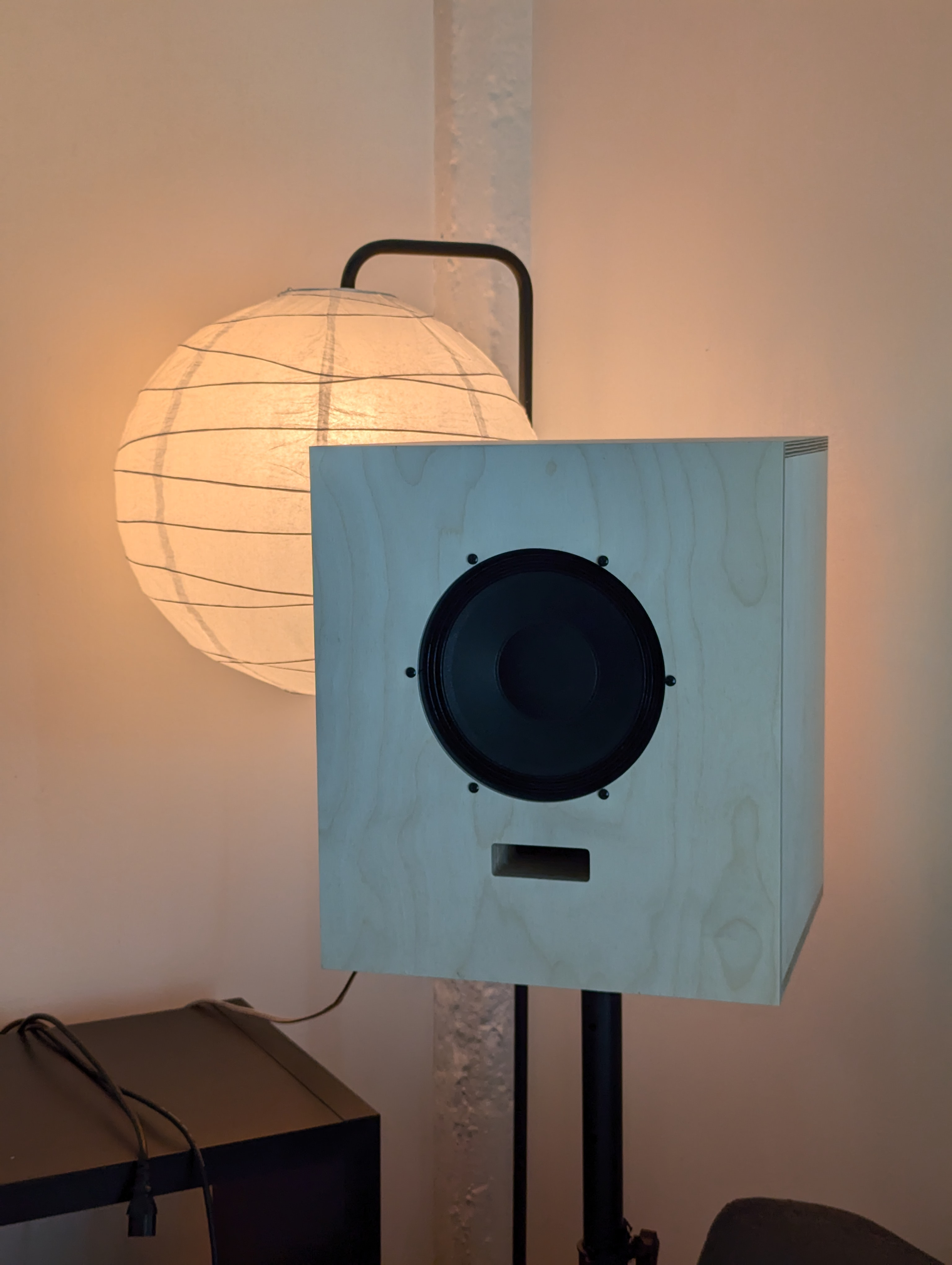
As a first foray into home Hi-Fi, these sounded good. Better, in fact, than most setups I’d heard short of dedicated rooms in stores and speakers north of $5k AUD. The first iteration paired them with a Wiim Amp and a NAD PP 2e phono preamp into a Technics 1210. The sound was great but the obvious flaw was the lack of low end, which I later fixed with a subwoofer dialled back to sit quietly in the mix. I also tried the Wiim room tuning early on and didn’t like the results. Whether that was early software or my particular room and phone microphone, I’m not sure. About a year later, I’ve moved the speakers and retried the Wiim room tuning and it’s made a much better and noticeable difference so it was probably a combination of both the room and microphone.
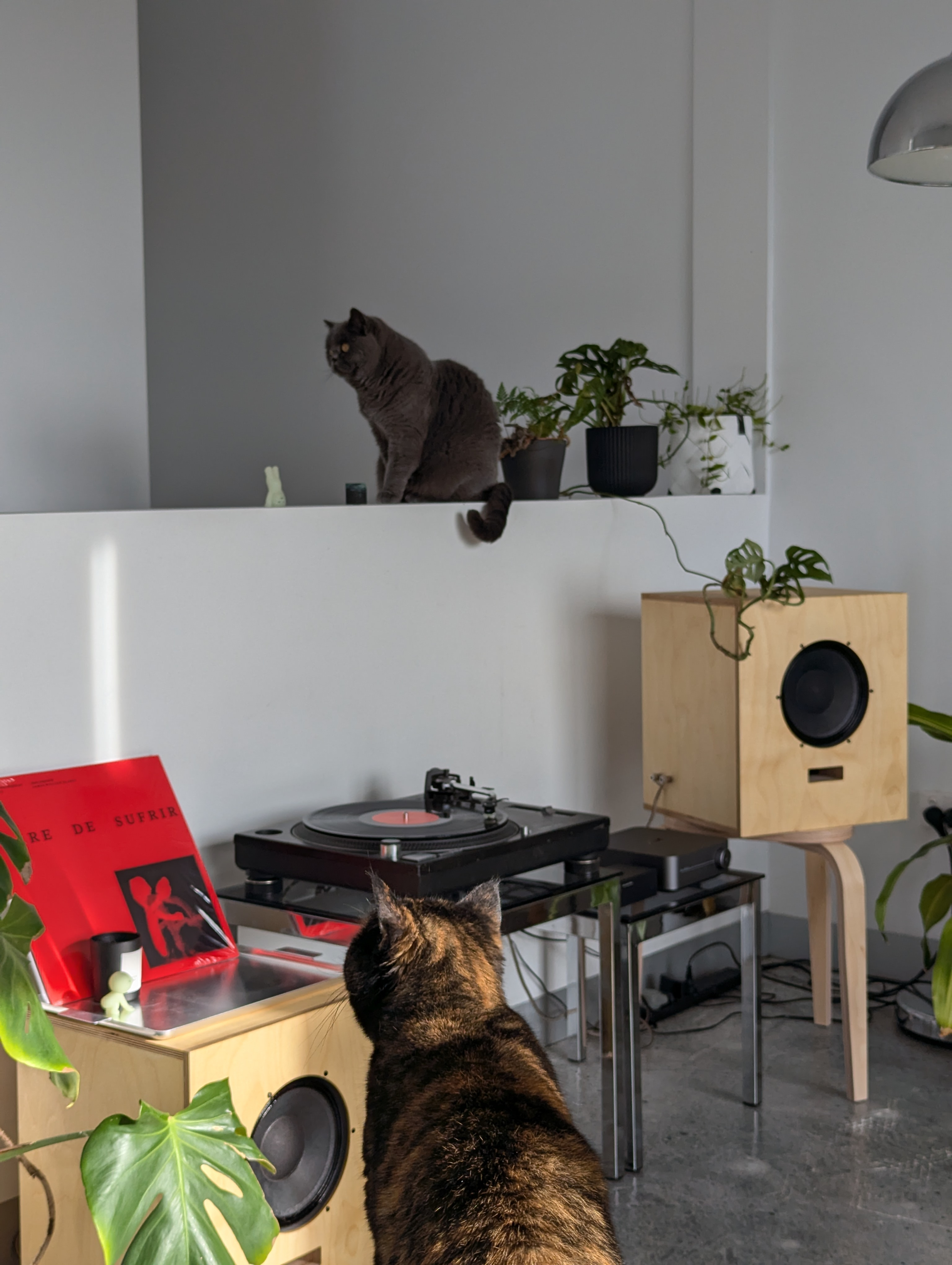
Yes, that’s an Ikea stool as a stand. And yes, I bought a second one shortly after to raise it. These were eventually replaced with custom aluminium stands, with no real difference to the sound, nor did I expect one given how low I tend to listen.
Tubes and the First Real Upgrade
After living with this for a while, I went to the 2025 Stereonet show to hear what tube amplifiers actually sounded like and to benchmark my setup against professional ones. That post has the detail. Shortly after, I came across a Stereonet marketplace listing for an amp and preamp pair that had been reviewed well on YouTube. They’re Chinese clones of well-regarded designs described as a perfect match: the Cary SLP-90 and the Dartzeel NHB-108 (D5 Pro), both reviewed by HiFi Zone.
These were a drastic improvement. If I had to sum it up: more clarity, with the music opening up and having space to breathe. Separation and imaging only improved slightly, but live recordings now had the air and atmospheric quality I’d been chasing, the same thing that stood out to me at the Stereonet show.
I later upgraded the tubes to PSVane Horizon 12AU7-AT, on another HiFi Zone recommendation, and got another step up in quality. I’m following advice at this stage since I’m still experimenting, but every recommendation so far has subjectively held up in practice.
Sources and Speakers
The preamp and amp combo also gives me four analog inputs to switch between. Beyond vinyl and streaming from the Wiim (local files and Tidal), I tried a Raspberry Pi 3B with an audio interface as a source. It was clunky and I wasn’t a fan. I can see the appeal of something like the Wiim Ultra to streamline all of this.
Around then I picked up some CDs from my family home and wanted a physical source for them, so I found a Rotel RCD-855. It uses the Philips TDA1541A DAC chip, a cult classic. It’s a multibit, R-2R ladder converter, an older architecture that reconstructs the signal directly through a ladder of resistors rather than the sigma-delta method that came later, and supposedly provides it with its fuller, warmer midrange. The RCD-855 was a more affordable way into that sound and I was lucky to pick one up for a very low price locally.
I’d actually been hunting for a Sony ESD-series player first, after reading this Lampizator write-up on the CDP-333ESD. The interesting part is that Sony used the same TDA1541A chip, but built it into players with their top-tier all-metal KSS laser mechanisms and a very clean power supply. Lampizator (who currently designs and sells high end DACs and used to modify DACs and CDs to include tube amplification) rates these Sony players above Philips’ own machines using the same DAC, which is a strong claim given how revered the Philips ones are. He gets the best results by modifying them, not something I’d attempt now, but the kind thing I’d like to understand better down the track. .
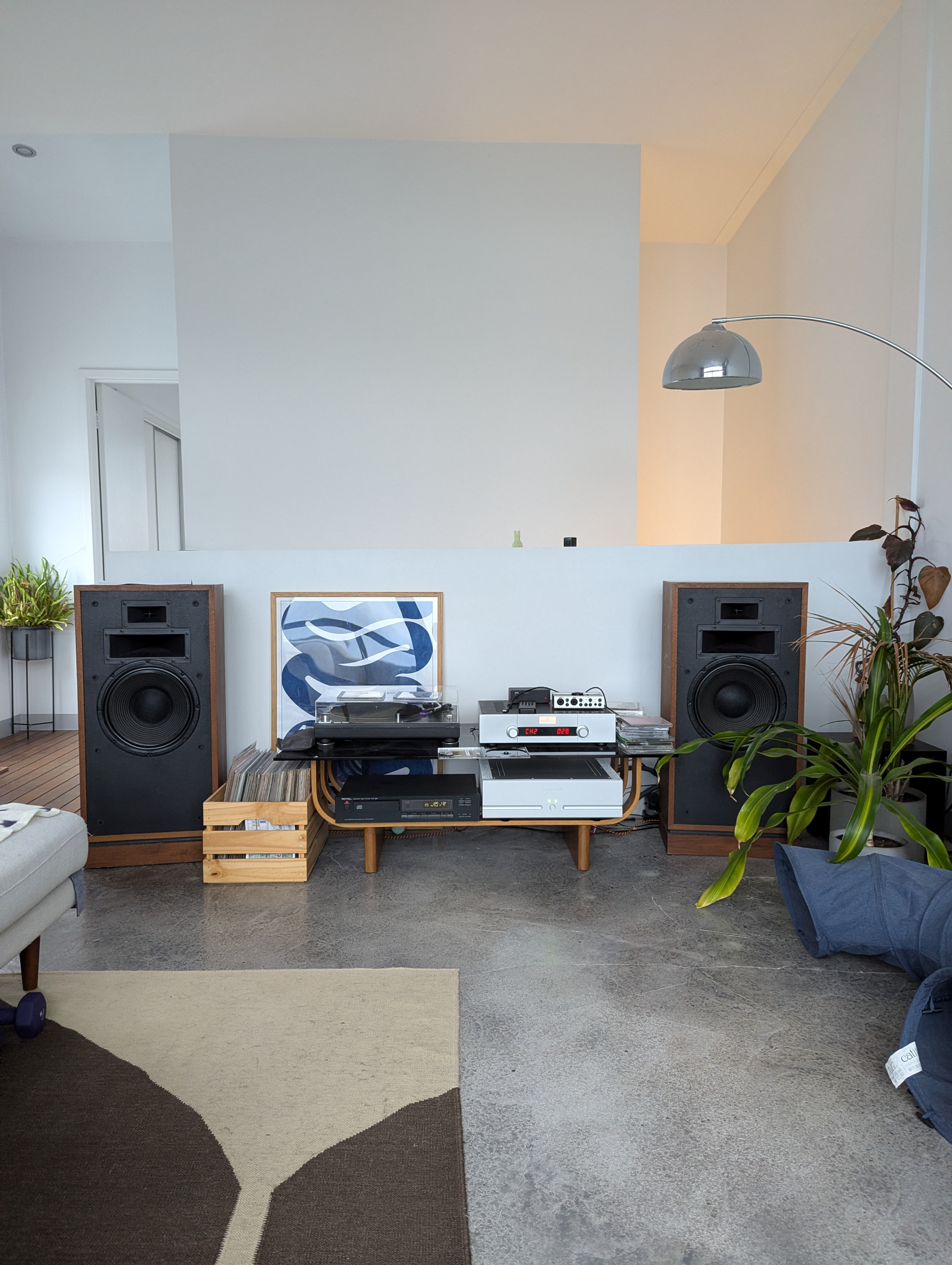
For speakers, I’d considered building a pair of Onkens, or a similar design from Joseph Crowe but they were far too large to carry up the stairs here, so that was out. Back-loaded horns looked like the simpler alternative, and I was about to build a pair when a set of Klipsch Forte v1s came up on marketplace. A rare find, and what I think is a genuine vintage collectable. Horn-based, which was the direction I wanted to go anyway.
In a word, the Fortes sound more mature. More depth, and a broader, bulkier sound than the Ojas Artbooks. Some forum users say a sub isn’t needed with the Fortes, but that wasn’t my experience, probably because I don’t have them up against a rear wall. The Forte v1 gets its low end from a rear-firing passive radiator, a cone no driver of its own that’s driven by the air pressure the woofer creates inside the sealed cabinet. It extends the bass in the same way a port would, but without port noise. Because it fires backward, the wall behind it reinforces that output, so pulling the speakers away from the wall thins the bass. A sub fills that back in, and the voicing is now clear and natural. There’s a common concern about horn speakers being shouty, but that isn’t the case here; the highs are delicate. That said, switching back and forth, the Ojas Artbooks still hold their own and bring a clarity I’d expect from the more modern drivers.
The Room
The current space can be partly seen in the photos. It’s a slightly irregular room. At the rear I can open the sliding doors or draw a heavy blockout curtain, which adds some dampening on top of the sofa and rug. Reflections are manageable as is, and I think only minimal treatment would be needed to get the best out of the speakers.
Where This Is Going
I’m still not chasing an end-game. I’m enjoying the process of refinement: new experiences to learn from, and continuing to work out what I actually like in the Hi-Fi world. Right now I’m loving the system and spending most of my time just exploring new music on it.
There are a few next steps. The clearest improvement would be room tuning. I plan to take measurements with Room EQ Wizard and apply a correction filter through a MiniDSP. I’d rather do this myself than go the Dirac Live route, which is a more pre-packaged commercial solution, since the point is partly to learn how it works.
The other weak link is the phono stage. My NAD PP 2e has fallen behind the rest of the system. Vinyl offers a different kind of experience requiring attentiveness and engagement, so it’s worth getting more out of it. An upgrade is on the cards, either a Chinese clone of a good design or a DIY build.
Further out, I want to start taking proper speaker measurements so that changes can be compared quantitatively rather than just by ear. It’s exciting to have things to try and learn.
At the end of the day though, the recording quality is the real ceiling on how good any of this can sound. And beyond sound quality, it’s worth remembering that music is meant to be felt, not just analysed. There’s a lot of good music out there to explore.